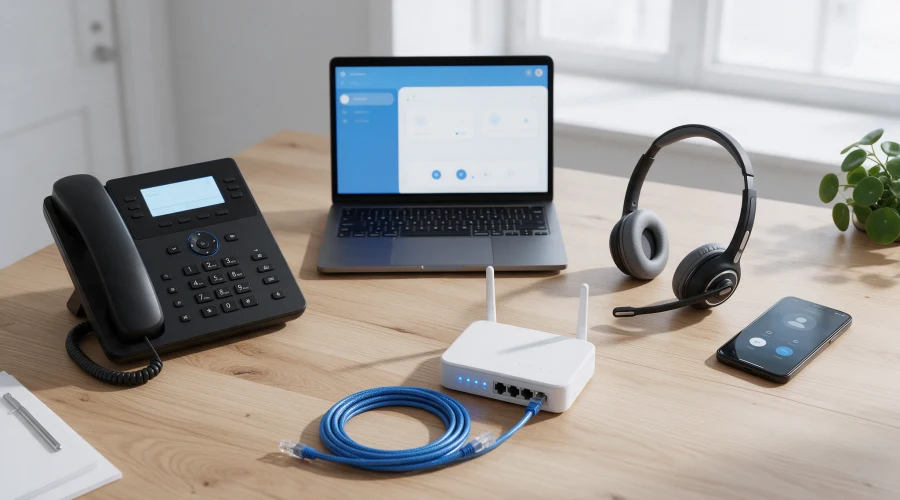

VoIP Phone Service: The Complete Guide to Upgrading Your Business Communications in 2026

Discover how a VoIP phone service can cut costs, boost productivity, and modernize your business. Learn features, benefits, and how to choose the right provider.
If your business still relies on a traditional phone system, you could be overpaying and missing out on features that modern teams depend on. A VoIP phone service replaces outdated landlines with internet-based calling, giving you crystal-clear audio, advanced call management, and significant cost savings. Whether you run a startup, a growing mid-size company, or manage a remote workforce, understanding how VoIP works can help you make a smarter decision about your communications infrastructure.
What Is a VoIP Phone Service?
VoIP stands for Voice over Internet Protocol. In simple terms, a VoIP phone service converts your voice into digital data packets and transmits them over the internet rather than through copper telephone wires. This means you can make and receive calls from any device with an internet connection, including desk phones, laptops, tablets, and smartphones.
Unlike traditional phone lines, which require expensive physical infrastructure and per-line fees, VoIP leverages the broadband connection you already pay for. The result is lower monthly bills, greater flexibility, and access to features that legacy systems simply cannot match.
Key Benefits of Switching to a VoIP Phone Service
1. Significant Cost Savings
One of the most compelling reasons businesses adopt a VoIP phone service is the potential for dramatic cost reduction. Traditional phone lines charge per line, per minute for long-distance, and often add hidden fees for features like call forwarding. VoIP bundles these features into affordable monthly plans, often cutting communication costs by 30 to 50 percent.
2. Flexibility and Mobility
Remote and hybrid work is no longer optional for many businesses. A VoIP phone service lets employees take their business line anywhere. They can answer calls from a mobile app on a train, participate in a video conference from a home office, or transfer calls between devices seamlessly. This level of mobility keeps teams productive no matter where they are.
3. Advanced Features That Drive Productivity
Modern VoIP platforms go far beyond basic calling. Most providers include features such as:
- Auto-attendant and interactive voice response (IVR) menus
- Call recording, analytics, and real-time reporting
- Voicemail-to-email transcription
- CRM integrations for streamlined customer interactions
- Video conferencing and team messaging in a single platform
4. Easy Scalability
Adding a new line to a traditional phone system often means scheduling a technician visit and waiting days. With a VoIP phone service, you can provision new lines or extensions in minutes through an online dashboard. This makes VoIP ideal for seasonal businesses, fast-growing teams, or companies expanding to new locations.
How to Choose the Right VoIP Phone Service
Not every VoIP provider is the same. When evaluating options, consider the following factors to find the best fit for your organization:
Reliability and Uptime
Look for providers that guarantee at least 99.9% uptime and have redundant data centers. Downtime directly impacts your ability to communicate with clients, so reliability should be a non-negotiable criterion.
Security and Compliance
Voice traffic carries sensitive information. Choose a VoIP phone service that offers end-to-end encryption, complies with industry regulations such as HIPAA or GDPR, and provides robust access controls.
Integration Ecosystem
The best VoIP solutions integrate with the tools your team already uses, including CRMs like Salesforce and HubSpot, help desk platforms, project management tools, and calendar applications. Seamless integrations eliminate data silos and reduce manual work.
Customer Support and Onboarding
Switching phone systems can feel daunting. Providers that offer guided onboarding, number porting assistance, and 24/7 support make the transition smooth. Platforms like Coperato focus on simplifying business communications so you can stay focused on what matters most: running your business.
VoIP Phone Service vs. Traditional Landlines: A Quick Comparison
Still on the fence? Here is a straightforward comparison to help clarify the differences:
- Monthly cost per line: VoIP typically ranges from $15 to $35, while traditional lines can cost $40 to $70 or more.
- Long-distance calling: Most VoIP plans include unlimited domestic and sometimes international calling at no extra charge. Landlines bill per minute.
- Hardware requirements: VoIP works with existing devices or low-cost IP phones. Traditional systems require dedicated handsets and wiring.
- Scalability: VoIP lets you add or remove lines instantly online. Landlines require a technician and physical installation.
- Feature set: VoIP includes video conferencing, analytics, call routing, and integrations as standard. Landlines charge extra for basic features like call waiting.
Common Concerns About VoIP Phone Service
Will Call Quality Suffer?
With a stable broadband connection of at least 100 Kbps per call, VoIP delivers HD-quality audio that rivals or exceeds traditional phone lines. Many providers also use adaptive codecs that adjust quality based on bandwidth conditions in real time.
What Happens During an Internet Outage?
Reputable VoIP providers include failover features that automatically route calls to a mobile number or voicemail during outages. Cloud-based systems are designed with redundancy so that one local disruption does not bring down your entire phone network.
Is the Transition Difficult?
Most businesses complete the switch in a few days. Number porting preserves your existing phone numbers, and cloud-based setups require minimal hardware changes. A provider with a solid onboarding process can have you up and running with virtually zero downtime.
Getting Started with a VoIP Phone Service
Making the switch does not have to be complicated. Start by auditing your current phone expenses, listing the features your team needs, and testing a provider with a free trial or demo. Assess your internet bandwidth to ensure it can handle concurrent calls, and plan your rollout in stages if you have a large team.
If you want a solution that combines ease of use with powerful business communication tools, explore what Coperato has to offer. Their platform is designed to help businesses of all sizes transition to modern VoIP without the typical headaches.
Final Thoughts
A VoIP phone service is no longer a niche technology reserved for tech companies. It has become the standard for businesses that want reliable, feature-rich communications at a fraction of the cost of traditional phone systems. From startups to enterprises, organizations across every industry are making the switch and seeing measurable improvements in efficiency, flexibility, and customer satisfaction.
The sooner you move to VoIP, the sooner you start saving money and empowering your team with tools built for the way modern businesses operate.